
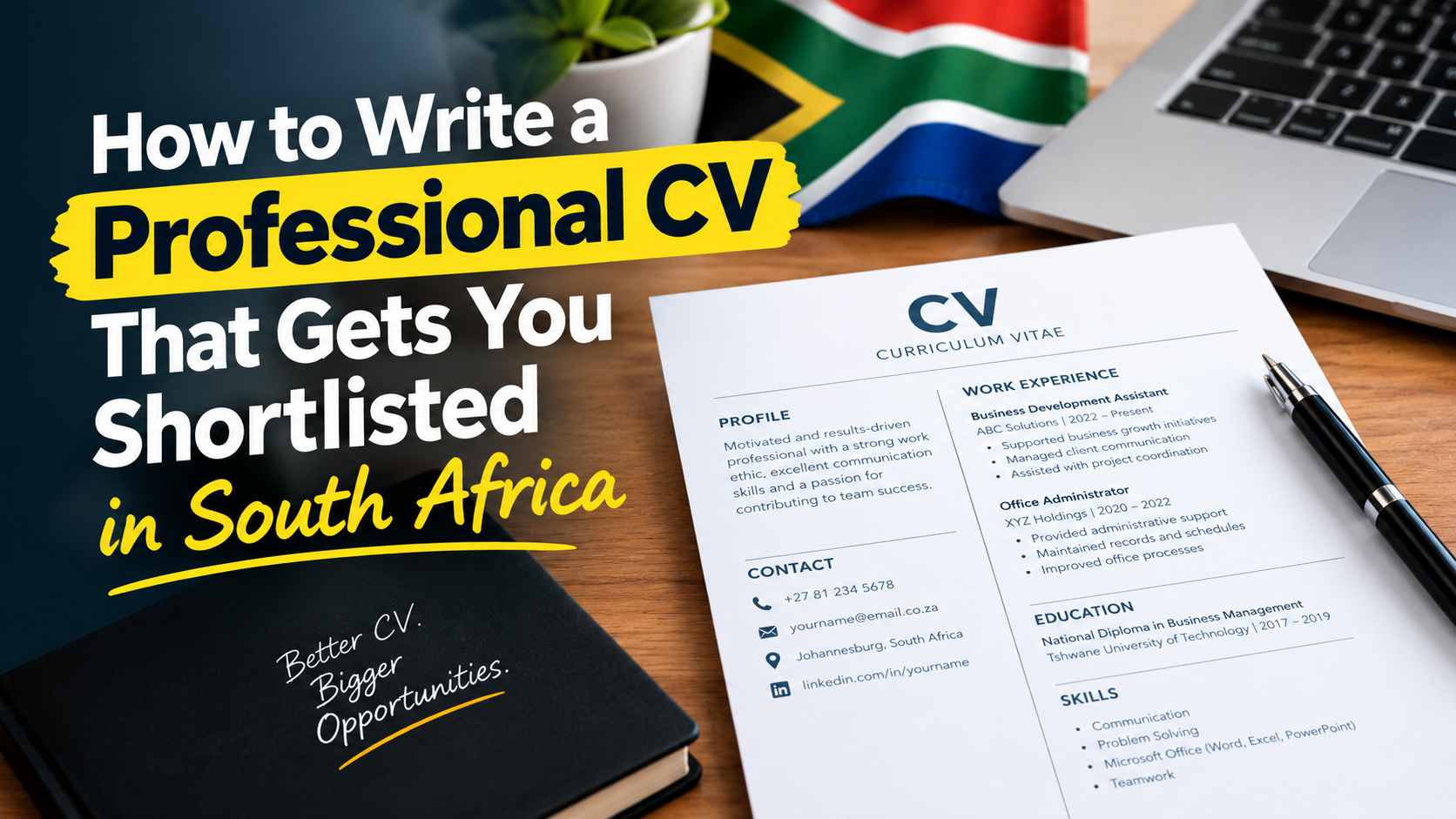
A professional CV is one of the most important tools you need when searching for a job in South Africa. Whether you are a recent matriculant, a university graduate, an experienced worker or someone looking for a career change, your CV helps employers understand your qualifications, skills and suitability for a position.
Many job seekers submit dozens of applications without receiving interview invitations. While there can be several reasons for this, a poorly structured CV, missing information or an application that does not match the advertised requirements may reduce your chances of being shortlisted.
The good news is that creating a professional CV does not have to be complicated. By presenting your information clearly, highlighting relevant skills and tailoring your application to each vacancy, you can make it easier for recruiters to recognise your potential.
In this guide, you will learn how to write a professional CV in South Africa, what information to include, which mistakes to avoid and how to improve your CV before applying for your next job.
1. Choose a Clear and Professional CV Format
Your CV should be easy to read and organised into clear sections. Recruiters often review many applications, so important information should be easy to find.
For most job seekers, a simple reverse-chronological format works well. This means listing your most recent work experience and qualifications first.
A professional CV generally includes:
- Personal and contact details.
- A professional profile or career summary.
- Education and qualifications.
- Work experience, where applicable.
- Skills and competencies.
- Relevant training and certificates.
- References, if requested or appropriate.
Use a readable font, consistent spacing and clear headings. Fonts such as Arial, Calibri or Aptos are suitable choices. Avoid excessive colours, decorative graphics and complicated layouts that make your information difficult to follow.
Recommended for you: How to Find a Job With No Work Experience in South Africa
For many entry-level applicants, two pages may be sufficient. Experienced professionals with extensive relevant experience may need more space. Focus on including useful information rather than trying to reach a particular page count.
2. Add Your Correct Contact Details
Your contact information allows employers to reach you if they want to arrange an interview or request additional information.
At the top of your CV, include your full name, professional email address, telephone number and general location, such as your town or city and province.
For example:
Name: Thabo Mokoena
Location: Polokwane, Limpopo
Telephone: Your current contact number
Email: yourname@example.com
Use an email address that looks professional and that you check regularly. Make sure your telephone number is correct and that your voicemail, where available, is suitable for professional communication.
In most cases, you do not need to include your full residential address, identity number, marital status or other sensitive personal details unless an employer has a legitimate reason to request specific information through an appropriate process.
A photograph is not generally necessary unless the employer specifically requests one or it is relevant to the role.
3. Write a Strong Professional Profile
Your professional profile is a short introduction that tells employers who you are, what you can offer and what kind of opportunity you are seeking.
Place it near the beginning of your CV, immediately after your contact details. Aim for approximately three to five sentences that reflect your actual background.
For an experienced administrative candidate, an example might be:
“Organised and detail-oriented administrative professional with experience in document management, data capturing, record keeping and office support. Skilled in communication, maintaining accurate records and handling administrative tasks efficiently. Committed to professionalism, accuracy and providing reliable support to daily business operations.”
If you have no work experience, focus on your education, transferable skills and willingness to learn.
For example:
“Motivated recent matriculant seeking an entry-level opportunity to develop practical workplace skills and gain professional experience. Possesses strong communication, teamwork and organisational abilities developed through academic activities and group projects. Eager to learn, follow instructions and contribute positively to an organisation.”
Avoid generic statements that do not explain anything about you. Your profile should be relevant to the position you are applying for.
4. Highlight Your Education and Qualifications
Education is particularly important if you are applying for learnerships, internships, graduate programmes or entry-level positions.
List your highest or most relevant qualification first. Include the qualification name, institution and completion year or expected completion date.
For example:
National Diploma in Human Resource Management
Name of Institution
Year completed: 2025
National Senior Certificate (Matric)
Name of School
Year completed: 2022
If you are still studying, indicate that your qualification is in progress and provide the expected completion date where appropriate.
Include relevant subjects, academic achievements or projects when they support your application. For technical positions, relevant modules or practical training may help demonstrate your knowledge.
Only include qualifications you have actually obtained or clearly identify those you are currently pursuing. Employers may request certificates or other supporting documents during recruitment.
5. Present Your Work Experience Effectively
If you have previous employment, list your most recent position first. Include the job title, employer, employment dates and a short description of your responsibilities and achievements.
Instead of writing a long paragraph, use concise bullet points.
For example:
Administrative Assistant | ABC Company | January 2024 – December 2025
- Maintained and updated office records and documentation.
- Assisted with data capturing and filing.
- Responded to telephone enquiries and directed requests to the appropriate departments.
- Supported daily administrative activities and helped maintain organised office systems.
Where possible, demonstrate the results of your work. If you helped improve a process, supported a project or handled a particular responsibility successfully, explain it accurately.
Avoid listing duties that you never performed or exaggerating your level of responsibility. Your CV should be a truthful representation of your experience.
6. What to Include If You Have No Work Experience
Not having formal employment history does not mean you cannot create a strong CV.
You can include relevant experiences that demonstrate your abilities, such as:
- Academic projects and practical assignments.
- Volunteering and community activities.
- Student leadership responsibilities.
- Internships and workplace training.
- Learnerships and apprenticeships.
- Relevant personal projects.
- Short courses and certificates.
For example, if you worked on a group project at college, you might explain how you researched information, organised tasks, prepared a presentation or collaborated with other students.
If you completed practical training as part of your qualification, describe the tasks you actually performed and the skills you developed.
Use an appropriate heading such as “Projects and Practical Experience” or “Volunteer Experience” rather than presenting these activities as paid employment.
The aim is to show employers that you have developed useful skills and are prepared to enter the workplace.
7. Include Relevant Skills and Competencies
Your skills section should reflect the requirements of the job you want.
Employers may look for technical abilities, communication, teamwork, problem-solving and attention to detail. However, different roles require different combinations of skills.
For an administrative position, relevant skills might include:
- Microsoft Word and Excel.
- Data capturing and record keeping.
- Professional communication.
- Filing and document management.
- Time management and organisation.
For a technical or engineering position, relevant skills might include equipment maintenance, fault-finding, technical documentation, workplace safety and the operation of relevant tools or systems, provided you genuinely possess those skills.
Do not include every skill you have ever encountered. Select the most relevant ones and support them with examples in your experience or project sections whenever possible.
You should also distinguish between skills you can perform independently and those you have only studied or observed.
8. Tailor Your CV to Each Job Advertisement
One of the most useful ways to improve your CV is to customise it for the position you are applying for.
Read the job advertisement carefully and identify the essential qualifications, responsibilities, experience and skills.
For example, if an administrative vacancy emphasises Excel, record keeping and customer service, make sure your CV clearly reflects your relevant experience in those areas if you have it.
If you are applying for an engineering learnership, highlight your relevant technical subjects, practical training, safety knowledge and qualifications.
Use the employer’s terminology naturally when it accurately describes your abilities. Some recruitment systems use software to help organise applications, and clear headings and relevant keywords can make your CV easier to process.
Never add false qualifications or claim experience simply because it appears in the advertisement.
9. Save and Submit Your CV Correctly
Before submitting an application, check the employer’s instructions. Some organisations request a PDF, while others specify a Word document or an online application form.
If PDF is accepted, it is often a practical choice because it helps preserve the document’s layout across devices.
Use a clear file name, such as:
Thabo_Mokoena_CV.pdf
Check that your CV opens correctly, all pages are included and the text is readable on a computer and mobile phone.
When applying by email, use a professional subject line that includes the position title and reference number if one is provided. Attach all required documents and write a brief, polite email.
Always submit your application before the closing date and follow the instructions in the vacancy advertisement.
10. Common CV Mistakes to Avoid
Small mistakes can make a CV appear less professional. Before applying, check for the following:
- Spelling and grammar errors.
- Incorrect telephone numbers or email addresses.
- Missing employment dates or qualification details.
- Unexplained gaps where clarification would be helpful.
- Excessive personal information.
- Unrelated skills and outdated details.
- Long paragraphs that are difficult to read.
- False claims about qualifications or work experience.
- Unprofessional email addresses.
- Missing documents requested in the advertisement.
Ask someone you trust to review your CV if possible. A second person may notice errors or unclear sections that you have overlooked.
You can also update your CV whenever you complete a course, gain a new skill, finish a project or obtain additional work experience.
Final Thoughts
Writing a professional CV is an important step towards improving your job search in South Africa. A clear structure, accurate contact details, a strong professional profile and relevant qualifications can help employers understand your suitability for a position.
If you have work experience, focus on relevant responsibilities and achievements. If you are starting your career, highlight your education, transferable skills, practical projects and willingness to learn.
Most importantly, tailor your CV to each opportunity and follow the employer’s application instructions carefully.
A professional CV cannot guarantee that you will be shortlisted, but it can help you present your experience and potential more effectively.