
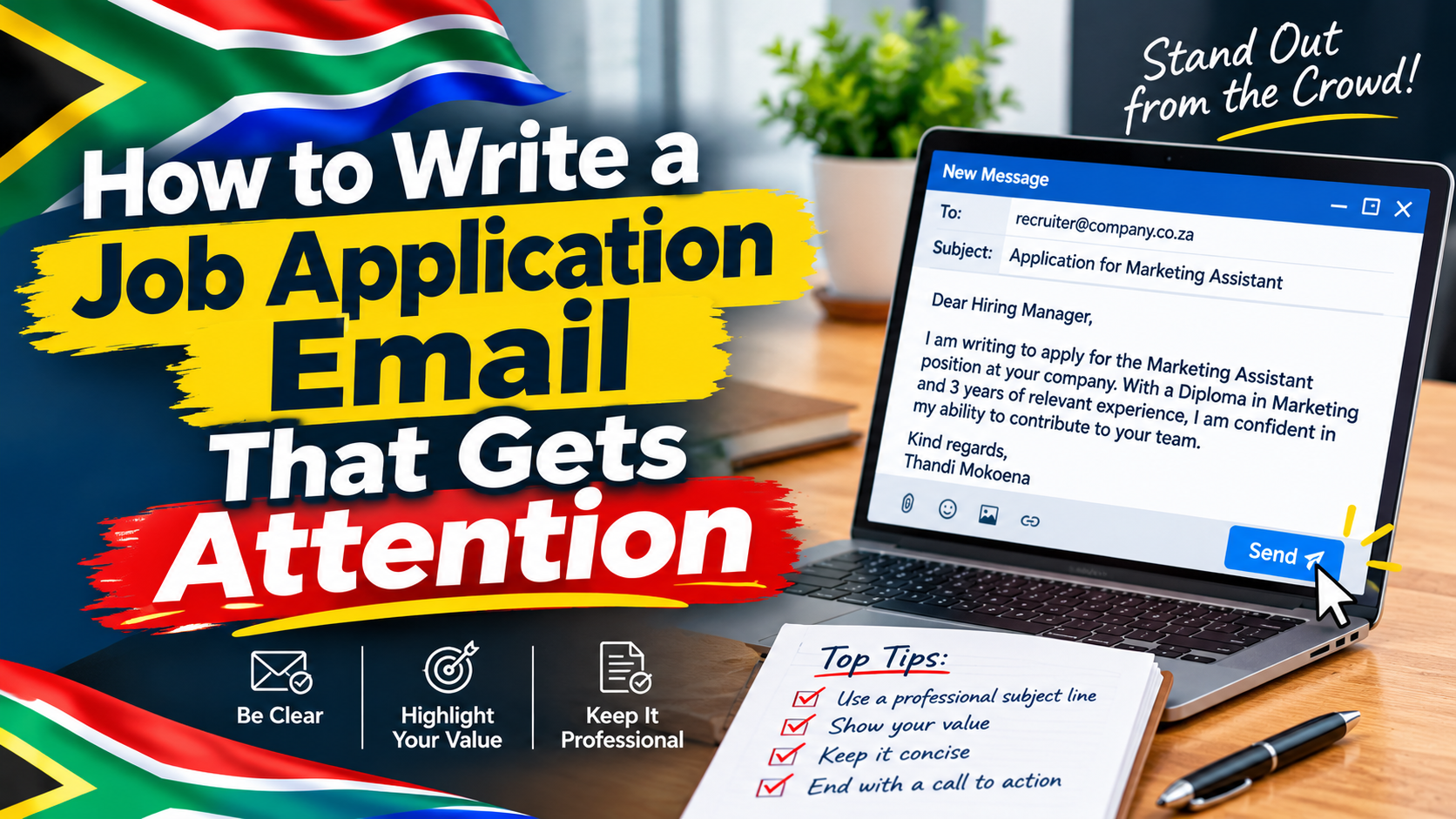
Applying for a job by email may seem simple, but the way you present your application can influence the impression you make on a potential employer. A professional job application email introduces you to the recruiter, explains which position you are applying for and directs attention to your attached CV and supporting documents.
In South Africa, many employers request that applicants submit their CVs and other documents by email. However, sending an email with no subject line, an empty message or missing attachments can make an application appear incomplete or unprofessional.
Whether you are a recent matriculant, a graduate, an experienced professional or someone applying for a learnership, knowing how to write a proper job application email is an important career skill.
The good news is that you do not need to write a long message. A clear subject line, a polite greeting, a short introduction and the correct attachments are often enough to create a professional application.
In this guide, you will learn how to write a job application email that gets attention, discover examples you can adapt and find out which common mistakes to avoid.
1. Use a Clear and Professional Email Subject Line
The subject line is one of the first things a recruiter sees when receiving your application. It should immediately communicate the purpose of your email.
Avoid vague subject lines such as “Job”, “CV Attached” or “Please Help Me”. These do not tell the employer which position you are applying for.
Instead, include the advertised job title and reference number if one is provided.
Examples include:
- Application for Administrative Clerk Position
- Application for General Worker – Ref: GW1026
- Application for Graduate Internship Programme 2027
- Application for Electrical Apprenticeship
- Application for Customer Service Representative
If the advertisement provides specific instructions for the subject line, follow them exactly. Some employers use reference numbers or job titles to organise applications.
A clear subject line helps the recruiter identify your application and reduces the risk of it being overlooked in a busy inbox.
2. Start With a Professional Greeting
Whenever possible, address the recipient by name if the employer has provided it.
For example:
“Dear Ms Mokoena,”
“Dear Mr Dlamini,”
If the advertisement does not identify a contact person, you can use a professional greeting such as:
“Dear Recruitment Team,”
“Dear Hiring Manager,”
Avoid overly casual greetings such as “Hey” or “Hi guys” when applying for a formal position.
A polite greeting establishes the right tone and shows that you are approaching the opportunity professionally.
3. Introduce Yourself and State the Purpose of Your Email
Your opening paragraph should explain why you are writing. Mention the position you are applying for and, where relevant, where you found the vacancy.
For example:
“I am writing to apply for the Administrative Clerk position advertised on your careers website. I am interested in this opportunity and believe that my administrative skills, attention to detail and commitment to professional development would enable me to contribute positively to your organisation.”
Keep your introduction short and relevant. You do not need to repeat your entire CV in the email because the recruiter can review your attached documents for further information.
If you are applying for a learnership or internship, mention the programme name and your relevant qualification or educational background.
4. Explain Why You Are a Suitable Candidate
After introducing yourself, briefly highlight the qualifications, skills or experience that relate to the position.
For an experienced applicant, this might include previous responsibilities, technical expertise or achievements.
For a recent graduate, it could include a relevant qualification, academic projects, practical training or transferable skills.
For example:
“I hold a National Diploma in Human Resource Management and have developed skills in administration, communication and record keeping. I am organised, eager to learn and interested in gaining further experience in a professional human resources environment.”
If you have no formal work experience, do not pretend otherwise. Focus on what you have learned and how your abilities relate to the opportunity.
Your aim is to encourage the recruiter to open your CV and consider your application.
5. Mention the Documents You Have Attached
Before sending your email, identify the documents included with your application.
Depending on the vacancy, these might include:
- Your updated CV.
- Certified copies of qualifications, if requested.
- Your matric certificate or academic transcript, if requested.
- A cover letter, if required.
- Proof of relevant training or professional registration, where applicable.
For example, you could write:
“Please find attached my CV and supporting documents for your consideration. I would welcome the opportunity to discuss my application further.”
Only mention documents that you have actually attached. Always check the advertisement to determine which documents are required.
Do not send unnecessary sensitive information unless the employer requests it through an appropriate process.
6. End With a Professional Closing
Finish your email politely and thank the recipient for considering your application.
Suitable closing statements include:
“Thank you for your time and consideration. I look forward to hearing from you.”
“Thank you for considering my application. I would welcome the opportunity to discuss my suitability for the position.”
End with a professional sign-off, such as:
“Kind regards,”
“Yours sincerely,”
Then include your full name and contact number.
Your email signature should make it easy for the recruiter to identify you and contact you if necessary.
7. Job Application Email Example for an Experienced Applicant
Below is a sample email you can adapt when applying for a position that matches your experience.
Subject: Application for Administrative Clerk Position
Dear Hiring Manager,
I am writing to apply for the Administrative Clerk position advertised by your organisation. I am interested in this opportunity and believe that my administrative knowledge, organisational abilities and attention to detail make me a suitable candidate.
My background has helped me develop skills in record keeping, communication, document management and general administrative support. I am committed to completing tasks accurately, working professionally with colleagues and contributing to efficient daily operations.
Please find attached my CV and the supporting documents requested in the advertisement for your consideration.
Thank you for your time and consideration. I would welcome the opportunity to discuss my application further.
Kind regards,
[Your Full Name]
[Your Contact Number]
Remember to replace the example details with your actual information and relevant skills.
8. Job Application Email Example With No Work Experience
If you are a matriculant, graduate or first-time job seeker, you can still write a strong application email without previous employment.
Subject: Application for Entry-Level Position
Dear Recruitment Team,
I am writing to express my interest in the entry-level position advertised by your organisation. I recently completed my [qualification] and am eager to gain practical workplace experience while developing my professional skills.
Through my education and other relevant activities, I have developed communication, teamwork, problem-solving and organisational skills. I am willing to learn, follow instructions and contribute positively to the team.
Please find attached my CV and the required supporting documents for your consideration.
Thank you for considering my application. I would appreciate the opportunity to discuss my suitability for the position.
Kind regards,
[Your Full Name]
[Your Contact Number]
This example is suitable for adapting to entry-level vacancies, but you should personalise it with your real qualification, strengths and the advertised position.
9. Job Application Email Example for a Learnership or Internship
Learnerships and internships often attract many applications. Your email should be clear, polite and specific about the programme.
Subject: Application for [Programme Name] – [Reference Number]
Dear Recruitment Team,
I am writing to apply for the [Programme Name] advertised by your organisation. I am interested in this opportunity because it would allow me to develop relevant skills, gain practical experience and build a foundation for my career.
I hold [your highest relevant qualification] and have an interest in [relevant field]. I am motivated to learn, work collaboratively and apply my knowledge in a professional environment.
Please find attached my CV and the supporting documents specified in the advertisement.
Thank you for your time and consideration. I look forward to the opportunity to be considered for the programme.
Kind regards,
[Your Full Name]
[Your Contact Number]
Before sending, confirm that you meet the programme’s requirements, including the qualification, age, citizenship or other eligibility conditions where applicable.
10. Common Job Application Email Mistakes to Avoid
Even a suitable candidate can create a poor impression by making avoidable application mistakes.
Here are some important things to check before sending your email.
Using an unprofessional email address: Create an email address that uses your name or a simple professional variation rather than an inappropriate nickname.
Leaving the subject line blank: Always include the job title and reference number when required.
Sending an empty email: Include a short introduction explaining why you are applying.
Forgetting attachments: Confirm that your CV and all requested supporting documents are attached.
Using the wrong company name: When applying for several jobs, review the recipient and message carefully before sending.
Writing too much: Keep your email focused. Your CV should provide the detailed information about your qualifications and work history.
Ignoring application instructions: Follow the employer’s requested format, file type, email address and submission deadline.
Using spelling mistakes and informal language: Proofread your message before sending it.
Sending documents in the wrong format: If the employer requests a PDF, do not send a Word document instead unless you have been given permission.
Applying after the closing date: Submit your application before the deadline and allow enough time to check your documents.
11. Should You Follow Up After Sending a Job Application?
Following up can be appropriate, but it is important to respect the employer’s recruitment process.
If the advertisement provides a response timeframe, wait until that period has passed before considering a follow-up. If no timeframe is provided, you may send a brief and polite enquiry after a reasonable period, provided the advertisement does not ask applicants not to follow up.
For example:
Subject: Follow-Up on Application for [Position Title]
Dear Recruitment Team,
I hope you are well. I am writing to politely enquire about the status of my application for the [Position Title] position, which I submitted on [Date].
I remain interested in the opportunity and would appreciate any update you are able to provide.
Thank you for your time.
Kind regards,
[Your Full Name]
Avoid sending repeated messages or contacting several employees about the same application within a short period. Some organisations receive large numbers of applications and may only contact shortlisted candidates.
Final Thoughts
Writing a professional job application email is a simple but important part of searching for employment in South Africa. A clear subject line, polite greeting, relevant introduction and correctly attached documents can help you present yourself professionally.
Whether you are applying for a permanent position, internship, learnership or entry-level opportunity, make sure your email reflects the requirements of the advertised vacancy.
Always check your contact details, confirm that your attachments are included and proofread the message before sending it. Most importantly, be honest about your qualifications, experience and skills.
A well-written email cannot guarantee an interview, but it can help you communicate your interest clearly and make it easier for an employer to review your application.
Before applying for your next job, take a few minutes to review your email. Make sure the subject line is clear, the message is professional and every required document is attached. These small steps can help you submit a more organised and complete application.